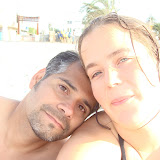
It had been hinted with little subtlety by family, friends and colleagues that Michael should take me to some nice places instead of keeping me trapped in Lima, so in the end we decided to go to Pisco for a short holiday between Christmas and New Year. Because Michael’s dear mum is not well, we did not want to go too far away, and besides it’s the rainy season in the highlands. Pisco is on the coast and only about 3 hours away.
We took the coach from central Lima in the morning on the 27th. This, naturally, included several mini buses to get to the actual coach station. Finally there, I was happily surprised at the standard of the coach. Michael had told me that sometimes the buses in the countryside have been put together using parts of old trucks, tractors or whatever else was lying around. The bus we took was not brand new, but clean enough and equipped with video screens and curtains (no toilet, but I prefer it that way, as the state of the toilets tends to deteriorate very quickly). As we moved out of the station and drove to the first bus stop along the Panamericana, uniformed coach staff moved up and down the aisle selling snacks and drinks of various kinds. We bought some habas – roasted giant beans that taste like crackers. The first film was “Kingdom of the sky” or whatever the English title of the film with Orlando Bloom and Jerusalem is. We passed the poorer and poorer outskirts of Lima, and I noticed that there is actually stairs built in the hills surrounding the city – painted yellow, they are too, so as not to be missed. The environs with occasional greenery smoothed the transition into the complete desert that makes up coastal Peru, from Chile to Columbia. After a while, we passed the extravagant hideaway of truly rich Limeñans – a small beach town which boasts all the commodities, including a shopping mall which is bigger than Plaza San Miguel and has its own cinema as well as everything else you might wish for. It put the later villages with their half finished brick houses, walls towards the Panamericana filled with brash Christal beer advertising, and dirt roads in stark relief.
Further south, near one of the rivers that carry water when it’s raining in the highlands, people were working the fields and growing things, for example wine. I kept a lookout for donkeys, which I’m still not used to seeing.
We finally got out at “el Cruz” – a crossing of a sand road with the Panamericana, with some shops and nearby houses. There, in the early and very hot afternoon, we were whisked into a taxi by some man, who got a sol from the taxi driver for his trouble (the taxi fare in total was only 5 soles). The taxi driver was very nice and gave us a briefing about Pisco while transporting us down a windswept gravel road between green fields with irrigation systems to the dusty town of Pisco, and our designated hostel, San Isidro. I was a little worried that there would be no rooms, as we hadn’t booked anything, and because it is the start of the summer and many people have holidays this week, Lima residents favour an exodus to the beach resorts. Fortunately, there was a nice en-suite “matrimonial” waiting for us. The hostels here very much in design and available facilities. This one, although very discreet on the outside (but nevertheless boasting a Lonely Planet entry), had a small but deep swimming pool in the centre, free laundry, a souvenir shop, breakfast kitchen and a separate kitchen for the guest’s convenience.
Having made use of the kitchen to eat our potatoes and camotes from the previous day along with a gigantic chirimoya (the most unlikely fruit I have ever tasted), we took a moto taxi down to the market to catch a bus to the beach.
A lot of the streets in Pisco are just packed sand and dirt, but what shocked me was the amount of garbage just lying around. According to Michael, the town just doesn’t have a properly organised garbage pick-up system, and so people rely on either disposing of domestic waste themselves or hiring someone else to do away with it for them – and where one person has dumped their leftover food or construction rubbish, anyone else can feel quite free to do the same. Down by the sea it got quite bad.
Apart from the glaringly obvious (the Peruvian national alcohol), Pisco is famous for its national park, the desert reserve Paracas, which includes the Ballestas islands where sea lions and a huge variety of birds compete for nesting and mating space. Ironically, three important industrial sectors are also represented within the reserve; fish meal factories and gas/oil refineries line parts of the shore, while the islands have been slightly modified to accommodate for the collection and transport of guano (low brick walls sit on top of the islands to make sure the guano stays put and is not lost into the sea). This, of course, does little for the natural landscape. But we still managed to visit some breathtakingly beautiful spots along the way...
skip to main |
skip to sidebar